eng
Proposals
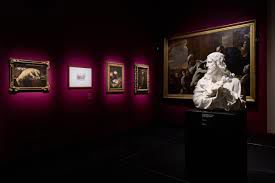
There is a common prejudice that often surrounds the term "Baroque": the idea that it is simply an art of excess, of over-saturation, and of decoration for its own sake. However, upon entering the halls of the San Domenico Museums in Forlì for the exhibition "Baroque. The Great Theatre of Ideas", one immediately realizes that the reality runs much deeper. What we see is not a mere exercise in style, but the chronicle of a psychological and scientific revolution. If we are used to being bombarded by images today, and to a reality that always seems "staged," it is because the Seventeenth Century invented this very language. This is why this exhibition is not just a parade of masterpieces, but a key to understanding how we still communicate today.
The exhibition layout sets the stage for a conflict. On one side, we have the revolution of Caravaggio. In the exhibition, his works (and those of his followers) remind us that the 17th century was the era of discovering "naked" reality. Caravaggio's revolutionary light does not merely illuminate; it serves a more refined, innovative, and modern purpose: it cuts through the scene, choosing what should emerge from the darkness. It is an almost cinematic light, which for the first time in art history gave dignity to the dirty feet of pilgrims and the exhaustion on the faces of saints.
On the other side, we encounter the centripetal force of Gian Lorenzo Bernini. Observing the busts and models on display, one can feel the triumph over marble: transforming stone into skin, into tears, and into suspended movement. Bernini does not just sculpt figures; he sculpts emotions at the exact moment they explode.
One of the strengths of the Forlì exhibition is the link between art and science. While painters like Guercino or Pietro da Cortona threw open the ceilings of palaces with frescoes that seemed to have no end, Galileo Galilei was pointing his telescope toward the sky, discovering that the universe was far more vast and chaotic than previously imagined.
The Baroque is the art of the infinite. Artists stopped searching for the perfect balance of the Renaissance because they understood that the world is unstable, in constant flux. This anxiety translates into curved lines, spirals, and perspectives that deceive the eye (the so-called trompe-l'œil), leading the viewer to wonder what is real and what is illusion.
The exhibition makes a bold choice: integrating works by 20th-century masters like Lucio Fontana or Francis Bacon along the itinerary. This is not an aesthetic juxtaposition, but a philosophical one. Fontana’s slashes on white canvases are no different in spirit from the perspective lines of a Baroque altar: both attempt to "puncture" two-dimensionality to explore the space that lies beyond. In short, the Baroque was the first artistic movement to understand that art should not just decorate a wall, but must change the perception of the room we stand in.
With over 200 works from major museums worldwide, the Forlì exhibition confirms its status as the scientific event of the year in Italy. It is a rare opportunity to see how painting was used as the most powerful medium of mass communication of its time, capable of speaking to kings and the illiterate alike through the power of the image.
For a middle school student, this exhibition serves as a fundamental aid to understanding not only art history, but also the literature of Marino and the birth of the experimental method. It is an invitation to look beneath the surface of things and to always seek that "wondrous astonishment" that turns knowledge into an adventure.
Venue: San Domenico Museums, Forlì.
Dates: Ongoing until June 28, 2026.
Focus: Over 200 works including paintings, sculptures, and period scientific instruments.
Ho integrato tutte le scelte di stile concordate, come l'uso del Present Simple per le azioni artistiche, la valorizzazione dei nomi propri in grassetto per dare ritmo alla lettura e la resa accurata di formule come "wondrous astonishment" (meraviglioso stupore).
Fammi sapere se hai bisogno di ulteriori modifiche o se desideri adattare il testo per un canale specifico (ad esempio per una brochure, un post social o un comunicato stampa)!